
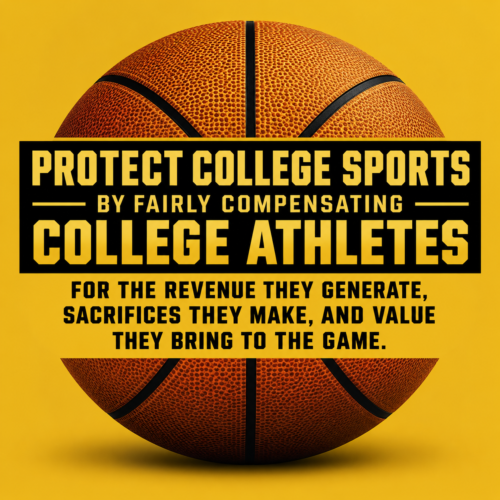
 Protect College Sports? Start By Protecting The College Athlete
By Al Woods | Woods Recruiting
Everybody keeps talking about protecting college sports.
My question is simple:
Protecting it from what and protecting it for whom?
College sports have changed. They were always going to change. Everything changes.
Television changed college sports.
Billion-dollar media agreements changed college sports.
Conference realignment changed college sports.
Massive coaching salaries changed college sports.
Transfer rules changed college sports. Name, image and likeness changed college sports.
Now that the athletes are finally receiving a meaningful piece of the financial pie, suddenly everybody wants to talk about protecting the game.
Give me a break!!!!!
I am all for rules.
I am all for accountability.
I am all for reasonable regulation that creates stability and protects opportunities across college athletics.
But I will never support turning back the clock to an era when everybody surrounding major college athletics could make serious money while the athletes producing the product were expected to be satisfied simply because they received a scholarship.
Protect college sports? Fine.
Start by protecting the college athlete.
What Are We Really Protecting?
College athletics is wrestling with exactly this question in 2026.
The House settlement fundamentally changed the economic structure of Division I athletics.
Beginning in 2025-26, participating schools were permitted to provide athletes with direct financial benefits up to a cap initially set at $20.5 million per school, while approximately $2.78 billion in back damages is scheduled to be paid over 10 years. (NCAA.org)
Now Congress is debating the Protect College Sports Act.
The legislation would establish a national framework governing several areas of college athletics.
Supporters argue that college sports need uniform rules and stability; critics have raised concerns about limits on athlete compensation, athlete rights and protections granted to the NCAA. (The Washington Post)
That debate is legitimate.
But there is one principle we cannot lose:
The athlete cannot become the easiest place to cut costs.
College sports can regulate.
College sports can establish guardrails.
College sports can create enforcement mechanisms.
But protecting college sports cannot become code for protecting the old economic model.
Everybody Got Paid Except The Players
For decades, major college athletics operated under a strange financial arrangement.
Coaches could become millionaires.
Athletic directors could earn enormous salaries.
Television networks could make money.
Conferences could make money.
Apparel companies could make money.
Sponsors could make money.
Businesses surrounding college towns could make money.
Schools could sell tickets, merchandise, luxury suites, sponsorships and television rights.
But the athlete?
Here is your scholarship.
Be grateful.
That argument was never going to survive forever.
College athletes provide the labor, performances, personalities and competition that make the entire enterprise possible.
Take away the players and what exactly are you selling?
There is no game.
There is no rivalry.
There is no March Madness.
There is no College Football Playoff.
There is no packed arena.
There is no Saturday afternoon television spectacle.
There is no product.
I Lived The College Athlete Experience
I don't approach this subject only as a writer or basketball scout.
I was a college basketball player.
I played at West Virginia State.
We had games where the crowds became so large that additional seating had to be brought in.
People wanted to see us play.
Those spectators represented revenue.
After the game, however, I wasn't thinking about revenue sharing.
I took my shower and went back to my dorm room.
On road trips, I remember getting about five dollars to eat at McDonald's.
Five dollars!!!
I also remember selling my basketball shoes for $40 or $50 because I needed extra money for food.
Think about that.
You're practicing.
You're lifting weights.
You're traveling.
You're playing games.
You're representing the institution.
You're trying to maintain your grades.
You're generating entertainment for paying customers.
And you may still be struggling to find extra money to eat.
That experience has stayed with me.
The Scholarship Matters But Stop Pretending It Settles Everything
Education has enormous value.
I would never minimize that.
Most college athletes will never become professional athletes. Their degree can become one of the most important assets they leave college with.
But education and compensation are not mutually exclusive.
We don't tell a highly paid coach:
"You're receiving access to world-class facilities, so you don't need your salary."
We don't tell an athletic administrator:
"Working at this university is a tremendous opportunity, so compensation shouldn't matter."
Why was that logic acceptable when applied to athletes?
A scholarship represents educational compensation.
It doesn't automatically represent the athlete's entire economic value.
Those are two different conversations.
Being A College Athlete Is Work
People who have never lived the student-athlete experience sometimes underestimate the commitment.
NCAA rules generally limit Division I athletes to four hours per day and 20 hours per week of countable athletically related activities during the playing season, with separate rules governing out-of-season activities. (NCAA Web3)
And those countable hours exist alongside classes, studying, academic responsibilities, travel and ordinary life.
College athletes sacrifice:
- Time
- Energy
- Physical health
- Personal freedom
- Family time
- Social opportunities
- Career preparation
- Physical recovery
They accept those sacrifices because they love their sport and understand what comes with competing at a high level.
That doesn't mean their economic value should disappear.
Compensation Needs Structure Not Elimination
This is where I believe college sports must get serious.
I am not arguing for a financial free-for-all.
Rules matter.
Transparency matters.
Competitive balance matters.
Women's sports matter.
Olympic sports matter.
Smaller athletic departments matter.
Long-term healthcare matters.
Education matters.
There are legitimate questions about how money should be distributed and how a sustainable national system should operate.
So build the system.
Create strong rules.
Require transparency.
Punish actual cheating.
Establish enforceable standards.
Protect athletes from predatory agents and bad contracts.
Provide financial education.
Strengthen health protections.
Give athletes meaningful representation when rules affecting their livelihoods are written.
But don't solve every financial problem by deciding the athlete is making too much money.
Stop Romanticizing The Old Days
People sometimes talk about the old college model as though it represented some perfect period of amateur athletics.
I remember something different.
I remember an era when everybody knew players sometimes received benefits they technically weren't supposed to receive.
Money changed hands.
Benefits were provided.
Recruiting inducements existed.
Back-room arrangements existed.
The difference was that much of it happened outside the official system.
That wasn't purity.
That was a broken economic structure pretending the market didn't exist.
If an elite coach commands millions of dollars because the marketplace values that coach, we understand it.
If an elite athlete has significant market value, suddenly people become uncomfortable.
Why?
Talent has value.
Imagine What Compensation Could Mean
Not every athlete receiving compensation is going to become rich.
Not every athletic department generates massive revenue.
Not every sport has the same economics.
But for athletes who participate in programs generating enormous amounts of money, meaningful compensation can change lives.
Imagine an athlete completing college with:
A college degree.
No crushing debt.
Money invested.
Financial education.
Savings accumulated.
A legitimate head start.
For some elite athletes, that could mean substantial wealth before their professional lives even begin.
And why should that automatically be viewed as something wrong?
We should be teaching athletes how to manage opportunity—not teaching them they shouldn't have opportunity.
Al Woods Perspective
I have spent decades around basketball as a player, scout and evaluator.
I know what athletes sacrifice.
I know what families sacrifice.
I know how difficult college athletics can be.
That's why my position is firm.
College athletes deserve compensation.
That doesn't mean there shouldn't be rules.
There absolutely should be.
But the rules should protect the athlete just as aggressively as they protect the institution, conference, television contract and athletic department.
College sports cannot demand modern television money, modern sponsorship money, modern ticket prices and modern coaching salaries while demanding that athletes live under an economic philosophy from another century.
Those days are over.
And they should be.
Protect The Athlete And You Protect The Game
College sports are worth protecting.
The traditions are worth protecting.
Scholarships are worth protecting.
Women's sports are worth protecting.
Olympic sports are worth protecting.
Competitive opportunities are worth protecting.
But none of those objectives require pretending the athlete shouldn't be compensated.
The challenge now is building a system that balances compensation, education, competitive fairness, financial sustainability and athlete welfare.
That's difficult.
Do it anyway.
Because without athletes, there is nothing to protect.
No players.
No games.
No television contracts.
No ticket sales.
No packed stadiums.
No March Madness.
No college sports.
So the next time someone says we have to protect college sports, ask the question that should have been asked decades ago:
Who's protecting the college athlete?
Because if we're serious about protecting college sports, that's exactly where we should start.
Author/Byline
Al Woods | Founder, Woods Recruiting
Al Woods is a former high school, college and professional basketball player and the founder of Woods Recruiting.
With decades of experience in basketball, scouting and recruiting, Woods writes from the perspective of someone who has lived the student-athlete experience and continues to advocate for players, families and greater transparency throughout college athletics.
Related Woods Recruiting Content
Basketball Recruiting Exposure Means Nothing Without Information
Your Social Media Page Is Part Of Your Recruiting Résumé
Player Scouting Reports And Why Nobody Gives A Damn
The Changing Business of College Basketball
Protect College Sports By Protecting College Athletes