
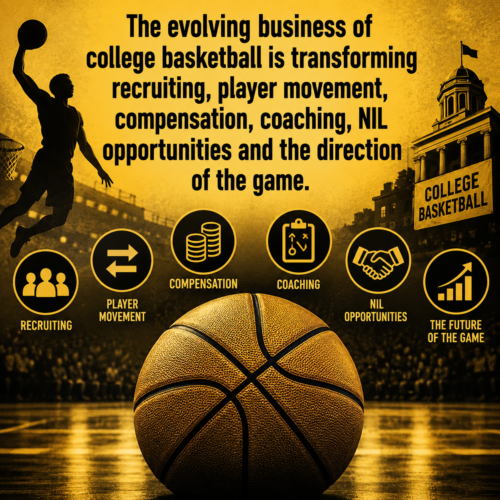
 The Changing Business Of College Basketball
College basketball has always been a sport. It has also always been a business.
The difference today is that nobody should be pretending otherwise.
Money has flowed through college athletics for decades.
Television contracts, ticket sales, sponsorships, merchandise, coaching contracts, conference distributions and postseason tournaments turned major college sports into an enormous commercial enterprise long before athletes were permitted to participate more directly in the economics surrounding their value.
Now the curtain has been pulled back.
Players have greater opportunities to earn money. The transfer portal has transformed roster construction.
NIL has created an entirely new marketplace. Revenue sharing and other changes have pushed the economics of college athletics even further into the open.
College basketball isn't dying.
College basketball is changing.
And everyone involved players, parents, coaches, administrators, scouts, agents and fans needs to understand the business that now exists alongside basketball.
Main Question: What Is Happening To College Basketball?
The traditional model was relatively simple.
High school players were recruited, signed with a college, developed within that program and ideally remained there for several years.
That model hasn't disappeared, but it is no longer the only model.
Today's environment includes:
- Transfer portal movement
- NIL opportunities
- Revenue sharing
- International recruiting
- Roster management
- Collective involvement
- Professional representation
- Conference realignment
The modern college basketball coach isn't simply recruiting high school players anymore.
Coaches must recruit transfers, evaluate international prospects, retain their existing roster and navigate financial considerations surrounding players.
That is a fundamentally different job.
Original Analysis: Basketball Has Become Roster Economics
One of the biggest changes is that talent evaluation can no longer exist independently of roster economics.
A coach might love a high school prospect, but that player is competing for a roster opportunity against experienced college transfers and international prospects.
A current college player might perform well but still enter the portal looking for a larger role, different environment or better financial opportunity.
Programs must constantly evaluate questions that barely existed in the old system.
Who should we recruit?
Who should we retain?
Where should resources go?
Which players fit?
What does the roster need immediately?
College basketball has moved closer to professional-style personnel management while retaining its educational structure.
That creates opportunity but also enormous complexity.
The Players Are Part Of The Business
This is where the conversation sometimes becomes uncomfortable.
People were comfortable with college basketball generating substantial revenue when most of the money circulated around the athletes.
Coaches could earn millions.
Administrators could earn substantial salaries.
Conferences could negotiate major television agreements.
Networks could sell advertising.
Apparel companies could build sponsorship relationships.
But once players gained greater economic opportunities, suddenly people began worrying that money was changing college basketball.
Money didn't suddenly arrive.
The players finally became more directly involved in the economics.
That doesn't mean the current system is perfect.
Regulation, transparency, contracts, eligibility rules and enforcement will continue to evolve.
But pretending college basketball can simply return to an earlier era ignores the economic reality surrounding the sport.
Supporting Information: Recruiting Has Changed Forever
High school recruiting may be where the impact becomes most visible.
College coaches have more options.
An 18-year-old high school prospect isn't simply competing against other high school prospects anymore.
He or she may be competing against:
- Experienced college transfers
- International basketball prospects
- Older developed players
- Proven college producers
That changes recruiting strategy.
Potential alone may not always win.
Immediate production matters.
Roster fit matters.
Position scarcity matters.
Financial considerations matter.
That makes recruiting education increasingly important for high school families.
Actionable Advice
Student-athletes and families need to stop approaching recruiting as though the system hasn't changed.
Understand the marketplace.
Build relationships early.
Develop legitimate game film.
Research appropriate levels.
Communicate professionally.
Protect academic options.
Most importantly, players must continue developing.
Exposure without ability doesn't solve anything.
Social media followers don't guarantee scholarships.
A highlight video doesn't replace complete game evaluation.
The foundation remains the same: become a better basketball player.
Mistakes And Challenges
The biggest mistake families can make is believing more exposure automatically creates more opportunities.
It doesn't.
The modern environment requires strategy.
Players must understand where they realistically fit, while families must resist chasing every camp, showcase, ranking or social-media promise that appears in front of them.
There is another danger.
Money can distort decision-making.
Choosing a college exclusively because of short-term financial opportunities could become a mistake if playing time, academics, development, coaching relationships and long-term fit are ignored.
The biggest check isn't automatically the best opportunity.
Al Woods Perspective
I've watched basketball and recruiting evolve for decades, and I believe fighting change is usually less productive than understanding it.
College basketball isn't going backward.
The transfer portal isn't disappearing.
NIL isn't disappearing.
Player compensation isn't disappearing. International recruiting isn't slowing down.
The financial side of college athletics isn't suddenly going to become insignificant.
So we need to deal with reality.
I support players having opportunities to benefit financially from the value they help create.
At the same time, players need education, structure and trustworthy information because more opportunity also means more complicated decisions.
The answer isn't pretending the old system was perfect.
The answer is building a better system around the reality of today's game.
Conclusion
College basketball is entering an era where basketball decisions and business decisions increasingly intersect.
That will create problems.
It will also create opportunities.
The programs that adapt will operate differently.
Coaches will evaluate differently.
Players will make decisions differently.
Parents will need better information.
Scouts will have to understand more than rankings and statistics.
Through all of it, one truth remains.
Basketball still rewards talent, preparation, development, discipline and production.
The business surrounding the game may continue changing rapidly.
The game itself still has to be played.
And the people who understand both sides — basketball and business — will be far better prepared for whatever comes next.
Author/Byline
Al Woods Founder, Woods Recruiting
Independent Basketball Scout Recruiting Analyst Basketball Media Publisher
Al Woods brings decades of basketball experience as a former high school, college and professional player and longtime independent scout.
Through Woods Recruiting, he covers high school and college basketball, recruiting, grassroots basketball, player evaluation and the rapidly changing business surrounding the game.
This angle gives you room to build a larger “Changing Business of College Basketball” series around NIL, the portal, revenue sharing, international recruiting, roster economics and the shrinking opportunities for high school prospects.
Related Woods Recruiting Content
Basketball Recruiting Exposure Means Nothing Without Information
Your Social Media Page Is Part Of Your Recruiting Résumé
Player Scouting Reports And Why Nobody Gives A Damn
The Changing Business of College Basketball
Protect College Sports By Protecting College Athletes