
 Player Scouting Reports And Why Nobody Gives A Damn
Let’s get right to the point.
Nobody gives a damn about your scouting report.
At least, not simply because somebody wrote one about you.
Players and parents sometimes treat a scouting report like it is some kind of golden ticket.
Somebody evaluates the player, publishes a nice article, posts it on social media, and suddenly college coaches are supposed to come running.
That is not how recruiting works.
College coaches are evaluating hundreds, sometimes thousands of prospects.
They receive emails, direct messages, videos, recommendations, scouting reports, schedules, statistics, event information, and recruiting pitches constantly.
Your scouting report is competing against all of it.
So the real question isn't whether you have a scouting report.
The question is whether your scouting report is worth a college coach's time.
That's an entirely different conversation.
Why Should College Coaches Care?
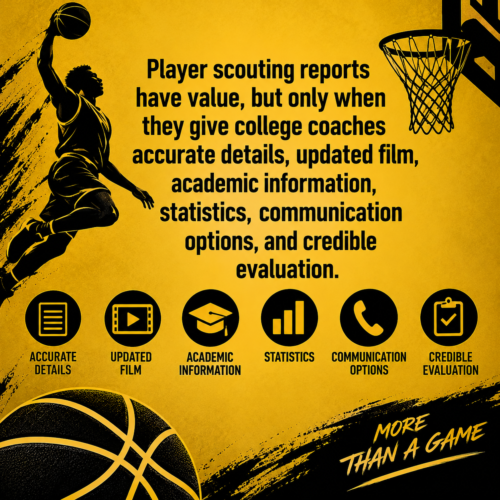
A scouting report should make evaluating a prospect easier.
That's its job.
It should quickly give a college coach useful information about the student-athlete and provide enough supporting evidence for that coach to investigate further.
That means the report needs substance:
- Accurate player information
- Current academic information
- Updated player statistics
- Quality game video
- Honest player evaluation
- School and team
- Graduation class
- Playing position
- Recruiting information
- Social media access
A scouting report containing little more than glowing adjectives isn't much of a scouting report.
"Great shooter."
"Outstanding athlete."
"High basketball IQ."
"Hard worker."
Wonderful.
Where's the evidence?
College coaches need information they can evaluate. Video is enormously important because coaches want to see prospects themselves.
The written evaluation should support the video not attempt to replace it.
One Scouting Report Isn't Enough
Here's another misconception that needs to disappear.
One scouting report isn't a recruiting strategy.
Recruiting develops over time.
Players improve.
Bodies change.
Statistics change.
Roles change.
Competition changes.
Academics change.
Video changes.
Your scouting information should change with you.
That is why having multiple evaluations over the course of your development can become valuable.
A report from sophomore year can establish where you were. Another evaluation months later can show development.
Updated reports can provide new video, statistics, accomplishments, and information.
You are building a recruiting résumé.
Think accumulation not miracles.
One article isn't supposed to make you famous.
You're building a body of evidence that says:
This player deserves another look.
Your Social Media Matters Too
At Woods Recruiting, our scouting reports include a link back to the student-athlete's social media page.
That creates another important question.
What will the college coach find when they click it?
This is where some players hurt themselves.
If your social media account is going to function as part of your recruiting presence, make it useful.
A coach should be able to quickly find:
- Current highlight videos
- Full-game footage
- Updated statistics
- Academic information
- Team information
- Playing schedule
- Recent accomplishments
- Scouting report links
Don't make coaches become detectives.
They don't have time.
Your social media page doesn't need to look like a corporate website, but if you're serious about college basketball, there should be enough basketball information there for a coach to continue evaluating you.
Make Yourself Easy To Evaluate
This is the part families sometimes overlook.
Exposure isn't just about getting seen.
It's about being easy to evaluate once you're seen.
Imagine a college coach discovers your name through a scouting report.
The coach watches your video.
Then clicks your social media account.
There are more clips.
Your statistics are current.
Your school is listed.
Your graduation year is obvious.
Your academics are updated.
Your schedule is available.
The information matches.
Now imagine the opposite.
Old video.
No graduation year.
No school information.
Outdated statistics.
Broken links.
Conflicting heights.
No academic information.
Which player is easier to investigate?
That's why details matter.
Be Smart With Contact Information
Players also need to think carefully about publicly posting personal phone numbers and email addresses.
Once information is publicly available, you cannot completely control who uses it.
Spam calls, unwanted messages, and junk emails are real possibilities.
You still need communication channels.
Social media direct messages can provide one option.
Players and families can also proactively contact college programs through appropriate channels and provide contact information directly when conversations develop.
The objective isn't hiding from coaches.
It's creating controlled accessibility.
Once legitimate communication begins, you can provide whatever appropriate information the coaching staff needs.
Imagine This Situation
Now imagine something better.
A college coach contacts you.
They're interested.
They want additional information.
Instead of scrambling around looking for video, statistics, grades, schedules, and links, you're prepared.
You send one link.
That link leads to a professionally written scouting report containing accurate information about you, an evaluation of your game, academics, statistics, video, and additional recruiting information.
The coach can evaluate everything immediately.
That's powerful.
Not because the scouting report magically got you recruited.
Because you were prepared when the opportunity arrived.
There's a huge difference.
Mistakes Players Must Avoid
Scouting reports lose value when the information surrounding them isn't maintained.
Watch out for:
- Outdated player information
- Old basketball footage
- Incorrect player measurements
- Inflated basketball statistics
- Missing academic information
- Broken video links
- Inconsistent player profiles
- Empty social accounts
- One-report dependency
- Passive recruiting expectations
And here's the biggest mistake:
Waiting to be discovered.
You can have the greatest scouting report ever written, but if nobody relevant sees it, what exactly did you accomplish?
Distribution matters.
Follow-up matters.
Relationships matter.
Repeated exposure matters.
The Al Woods Perspective
I've been around basketball long enough to understand that there are no magic buttons in recruiting.
A Woods Recruiting scouting report isn't designed to guarantee a scholarship.
It's designed to become another credible piece of a student-athlete's recruiting portfolio.
That's how families should view scouting reports.
Build the résumé.
Collect quality video.
Update your statistics.
Maintain your academics.
Develop your game.
Build relationships.
Contact college programs.
Keep your information accurate.
Get evaluated more than once.
Then keep going.
Your recruiting profile should become stronger every year because you are becoming a better basketball player and a better prospect.
Conclusion: Give Them A Reason To Care
So why does nobody give a damn about your scouting report?
Because nobody owes your scouting report their attention.
You have to earn it.
The report needs accurate information.
The evaluation needs substance.
The video needs to support the evaluation.
Your social media needs to provide additional information.
Your academics need to be current.
Your recruiting activity needs to continue beyond publication day.
Stop looking at a scouting report as the finish line.
It's ammunition.
It's another tool.
Another evaluation.
Another link.
Another piece of evidence.
Another opportunity to put useful information in front of college coaches.
And when that coach finally contacts you asking for more information?
Don't scramble.
Don't start searching for video.
Don't start wondering what to send.
Be ready.
Send them something so complete, accurate, organized, and professional that evaluating you becomes easy.
Now you've given them a reason to give a damn!!!
Author/Byline
By Al Woods | Founder & Lead Scout, Woods Recruiting
Al Woods is the founder of Woods Recruiting, an independent basketball scouting and recruiting media platform dedicated to evaluating student-athletes, educating families, and providing college coaches with information on prospects across the country.
A former high school, college, and professional basketball player, Woods brings decades of experience to player evaluation and recruiting education.
His philosophy is straightforward: players deserve honest evaluation, useful information, and an opportunity to be seen but they must be prepared when opportunity comes.
Related Woods Recruiting Content
Basketball Recruiting Exposure Means Nothing Without Information
Your Social Media Page Is Part Of Your Recruiting Résumé
Player Scouting Reports And Why Nobody Gives A Damn
The Changing Business of College Basketball
Protect College Sports By Protecting College Athletes