
 The Biggest College Basketball Recruiting Mistake Is Ignoring Opportunities Outside NCAA Division One
College basketball recruiting is much bigger than NCAA Division I.
Thousands of talented high school boys and girls dream about playing college basketball, earning scholarships, receiving financial assistance, and continuing their education.
Unfortunately, many student-athletes and parents do not fully understand the differences between college basketball recruiting levels.
Some believe Division I is the only level worth pursuing.
Others assume Division II is significantly inferior, Division III offers no financial opportunities, or junior college basketball is only for athletes with academic problems.
These assumptions can cost families valuable recruiting opportunities.
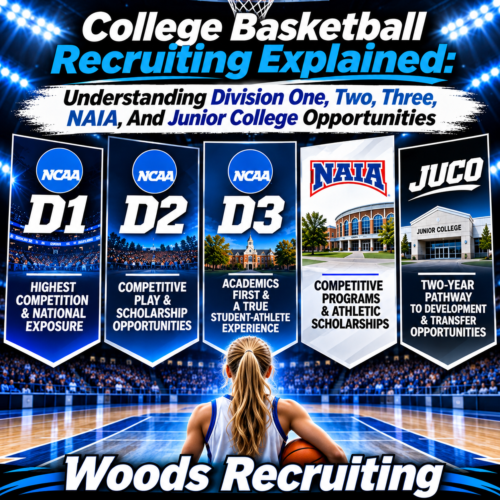
The reality is that NCAA Division I, Division II, Division III, NAIA, and junior college basketball each offer different competitive environments, scholarship possibilities, academic expectations, and recruiting opportunities.
Understanding these differences is critical.
At Woods Recruiting, we believe student-athletes should explore every realistic college basketball opportunity before making decisions that could influence their athletic and academic futures.
NCAA Division I Basketball: The Highest Profile Level
NCAA Division I basketball receives the greatest national attention. Major conferences, nationally televised games, enormous arenas, and the NCAA Tournament create tremendous excitement.
Naturally, talented high school basketball players dream about competing at this level.
However, Division I basketball is extremely competitive.
College coaches evaluate athletes nationally and internationally.
Many programs recruit players with outstanding athletic ability, advanced basketball skills, impressive physical measurements, and proven competitive experience.
The recruiting process can be unforgiving.
Important Division I considerations include:
- Extremely competitive recruiting environment
- Significant athletic performance expectations
- Demanding practice and travel schedules
- National and international recruiting competition
- Substantial institutional financial differences
Division I Scholarships
Division I basketball operates under roster limits and scholarship rules that have changed significantly in recent years.
For institutions operating under the current NCAA settlement-related roster-limit framework, basketball has a 15-player roster limit, and athletic scholarship opportunities can extend to eligible roster members. Scholarship funding still depends on institutional decisions and available resources.
Not every Division I program has the same financial resources.
Families must evaluate actual scholarship offers rather than assuming every Division I opportunity provides identical financial support.
NCAA Division II Basketball: Outstanding Competition And Financial Opportunities
One of the biggest recruiting mistakes is overlooking NCAA Division II basketball.
Division II programs feature talented athletes, experienced coaches, competitive conferences, and outstanding basketball environments.
Many Division II players possess skills comparable to athletes competing at certain Division I programs.
The primary differences often involve institutional resources, athletic budgets, recruiting exposure, and program structure.
Division II should never automatically be considered a disappointing alternative.
Division II Scholarships
Division II basketball generally operates under an equivalency scholarship model.
Programs can divide available athletic scholarship funding among multiple players, creating opportunities for partial awards.
Student-athletes may also qualify for academic scholarships, grants, and other institutional financial assistance.
Division II advantages can include:
- Competitive college basketball environments
- Athletic scholarship funding opportunities
- Academic financial assistance possibilities
- Strong coaching and player development
- Opportunities for meaningful playing time
A talented basketball player receiving significant Division II financial assistance may discover a better overall situation than accepting a poorly funded opportunity elsewhere.
The name of the division does not determine the value of the opportunity.
NCAA Division III Basketball: Never Ignore The Financial Possibilities
NCAA Division III basketball is frequently misunderstood.
The biggest misconception involves scholarships.
Division III institutions do not award athletic scholarships. However, that does not mean student-athletes cannot receive substantial financial assistance.
Many Division III institutions provide academic scholarships, institutional grants, and need-based financial aid.
Depending on the institution and family circumstances, these packages can make attendance financially attractive.
Competitive Basketball And Academics
Division III programs feature dedicated athletes, knowledgeable coaches, competitive conferences, and legitimate opportunities for basketball development.
Many institutions emphasize strong academic programs and the overall student-athlete experience.
However, Division III basketball still requires discipline, conditioning, practice, travel, and commitment.
Division III opportunities may include:
- Strong academic educational environments
- Institutional financial assistance opportunities
- Competitive college basketball programs
- Smaller campus community experiences
- Meaningful athletic development opportunities
Families should compare the actual net cost of attendance rather than dismissing Division III because athletic scholarships are unavailable.
A strong financial aid package can sometimes outweigh the value of a partial athletic scholarship elsewhere.
NAIA Basketball: An Overlooked Recruiting Opportunity
The National Association of Intercollegiate Athletics, commonly known as the NAIA, provides another valuable pathway for high school basketball players.
NAIA institutions compete nationally and offer legitimate opportunities for athletic scholarships, player development, and academic achievement.
The level of competition varies considerably among programs.
Some NAIA teams feature outstanding players capable of competing successfully against strong NCAA opponents.
Other programs provide opportunities for developing athletes who need additional experience.
NAIA Scholarship Opportunities
NAIA institutions can provide athletic scholarships, subject to association rules and institutional funding.
Families may also explore academic scholarships, grants, and other financial assistance.
The amount available varies significantly between institutions.
For student-athletes receiving limited NCAA interest, NAIA basketball deserves serious consideration.
Ignoring NAIA programs simply because they lack the NCAA label is a recruiting mistake.
Junior College Basketball: A Valuable Development Pathway
Junior college basketball offers opportunities for student-athletes who need additional academic preparation, physical development, playing experience, or recruiting exposure.
Many junior college programs compete through the National Junior College Athletic Association, commonly known as the NJCAA.
Junior college basketball is not exclusively for athletes experiencing academic difficulties.
Talented players sometimes choose this pathway strategically.
Why Junior College Makes Sense
A student-athlete may need another season to improve shooting consistency, develop strength, demonstrate leadership, or establish a stronger academic record.
Junior college can provide that opportunity.
Potential junior college advantages include:
- Additional basketball development opportunities
- Improved academic preparation possibilities
- Increased recruiting exposure potential
- Opportunities to demonstrate improvement
- Pathways toward four-year institutions
Scholarship availability depends on the junior college division, institutional funding, and program rules.
Transfer requirements also vary, so athletes should plan carefully with academic advisers.
Junior college is not a guaranteed pathway to Division I, but it can create valuable opportunities when approached strategically.
The Biggest Recruiting Mistake: Choosing A Division Instead Of An Opportunity
Here is something every basketball parent needs to understand.
The goal should not simply be playing Division I basketball. The goal should be finding the best possible college basketball opportunity.
Consider two student-athletes.
One receives limited interest from a Division I program offering uncertain playing time and modest financial assistance.
Another receives serious Division II interest, meaningful scholarship support, and a realistic opportunity to contribute.
Which situation is better?
The answer depends on academics, finances, basketball development, coaching relationships, and long-term goals.
A Division I label alone cannot answer that question.
Families must examine the entire opportunity.
How Woods Recruiting Helps Families Understand Their Options
At Woods Recruiting, we believe successful recruiting requires organization, realistic evaluation, college targeting, communication, and consistent exposure.
Our approach involves identifying college programs that match a student-athlete's basketball ability, academic qualifications, graduation timeline, and recruiting circumstances.
We encourage families to understand their options rather than becoming obsessed with one division.
The objective is to pursue appropriate opportunities, communicate with college programs, and help families make informed decisions.
No recruiting service can guarantee scholarships or placement, but a structured recruiting strategy can help athletes pursue opportunities they might otherwise overlook.
Final Evaluation: The Right College Basketball Level Matters
College basketball recruiting should never become a popularity contest between divisions.
Division I offers tremendous opportunities.
Division II provides competitive basketball and athletic financial assistance.
Division III offers academic and institutional aid possibilities.
NAIA programs create additional scholarship pathways. Junior colleges provide valuable developmental opportunities.
Every level deserves consideration when it fits the student-athlete.
Parents must understand that recruiting decisions influence far more than basketball.
They influence education, finances, personal development, and future opportunities.
Do not reject a college basketball opportunity simply because it belongs to a division you never imagined playing in.
The right opportunity may be waiting somewhere you have not considered.
Woods Recruiting is committed to helping high school boys and girls basketball players explore realistic college recruiting possibilities.
Your future is too important to limit your options before understanding them.