
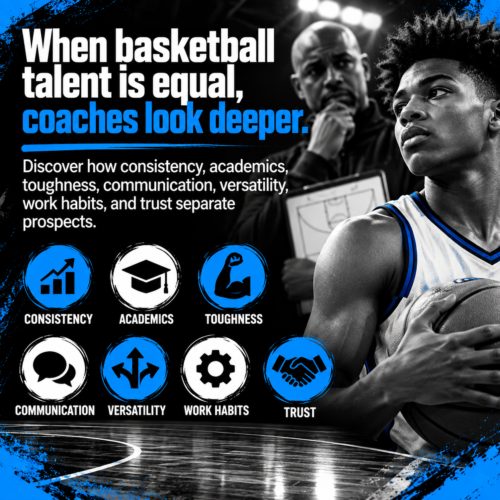
 When Talent Is Equal, What Separates The Prospect?
College basketball recruiting is not always about identifying the most talented player in the gym.
Sometimes the difficult decision comes when two prospects appear remarkably similar.
They may have comparable size, athleticism, statistics, skill levels, positions, and potential.
Both may play well against quality competition. Both may have impressive film.
So what breaks the tie???
Recruiting evaluations go deeper than points, rebounds, assists, and highlight videos.
When talent is relatively equal, everything surrounding the talent becomes increasingly important.
College coaches are evaluating the complete student-athlete.
Searcher's Main Question/Problem
High school basketball players often wonder why one prospect receives recruiting attention while another similarly talented player does not.
There may not be one single reason.
Coaches could be examining factors that never appear in a box score:
- Consistent competitive effort
- Strong academic performance
- Positive body language
- Effective player communication
- Multiple positional abilities
- Reliable daily habits
- Coachable competitive mindset
- Dependable personal character
Talent may get a prospect evaluated. Trust can help move that prospect further through the recruiting process.
Original Analysis
The closer two players are athletically, the more important the smaller details become.
A college coach is not simply recruiting what a player can do today.
The coach is considering what that athlete could become inside a college program.
Can the player accept coaching?
Will they compete when shots are not falling?
Can they handle limited playing time?
Will they communicate?
Can they defend multiple positions?
Will they attend class, remain academically eligible, and represent the program appropriately?
Those questions matter because recruiting is an investment of scholarships, roster spots, coaching time, player development, and program resources.
Supporting Information
Statistics provide valuable information, but they cannot measure everything.
Evaluators should watch what happens away from the basketball.
Watch the bench.
Watch warmups.
Watch reactions after mistakes.
Watch interactions with teammates, coaches, officials, opponents, and parents.
Small behaviors can reveal significant information.
Actionable Advice
Players trying to separate themselves should concentrate on controllable areas:
- Compete every possession
- Communicate with teammates
- Maintain strong academics
- Develop positional versatility
- Improve physical conditioning
- Demonstrate consistent habits
- Respond positively coaching
- Become highly dependable
Do these things consistently not only when college coaches are watching.
Mistakes/Challenges
One major mistake is believing talent automatically produces recruiting opportunities.
Another is concentrating entirely on scoring.
College programs need players who can fill roles, defend, communicate, practice hard, handle adversity, improve, and contribute to winning basketball.
A prospect who requires the ball constantly may actually have fewer ways to help a college team.
Al Woods Perspective
After decades around basketball, I believe one word deserves more attention in recruiting: trust!!!
College coaches need players they can trust.
Trust them to practice.
Trust them academically.
Trust them defensively.
Trust them to accept coaching.
Trust them when adversity arrives.
When two prospects possess similar talent, the player who consistently demonstrates reliability can create meaningful separation.
Conclusion
Talent remains important.
Size, athleticism, skill, production, and potential will always influence recruiting evaluations.
But talent is only part of the evaluation.
When prospects appear equal, the deciding factors can become consistency, academics, toughness, communication, versatility, work habits, character, coachability, and trust.
The question for every prospect should therefore go beyond, “Am I talented enough?”
Ask something harder:
“What separates me when everyone else is talented too?”
Author/Byline
Al Woods | Woods Recruiting
Al Woods is the founder of Woods Recruiting and a longtime basketball scout with decades of experience in the game.
A former high school, college, and professional basketball player, Woods evaluates prospects while providing independent scouting reports, recruiting education, and basketball insight designed to help student-athletes, families, coaches, and the basketball community better understand the recruiting process.